 Dedicated OFC Support
 Become a Partner

Demystifying PLC Splitters: How to Master Efficiency in Your FTTH Network Deployment
The global shift toward Fiber-to-the-Home (FTTH) connectivity hinges on one critical, often overlooked component: thePlanar Lightwave Circuit (PLC) Splitter. For network operators and ISPs, mastering the use, placement, and calculation of splitters is essential for a cost-effective and high-performance FTTH rollout.
1. The Challenge: Multiplying Connectivity Passively
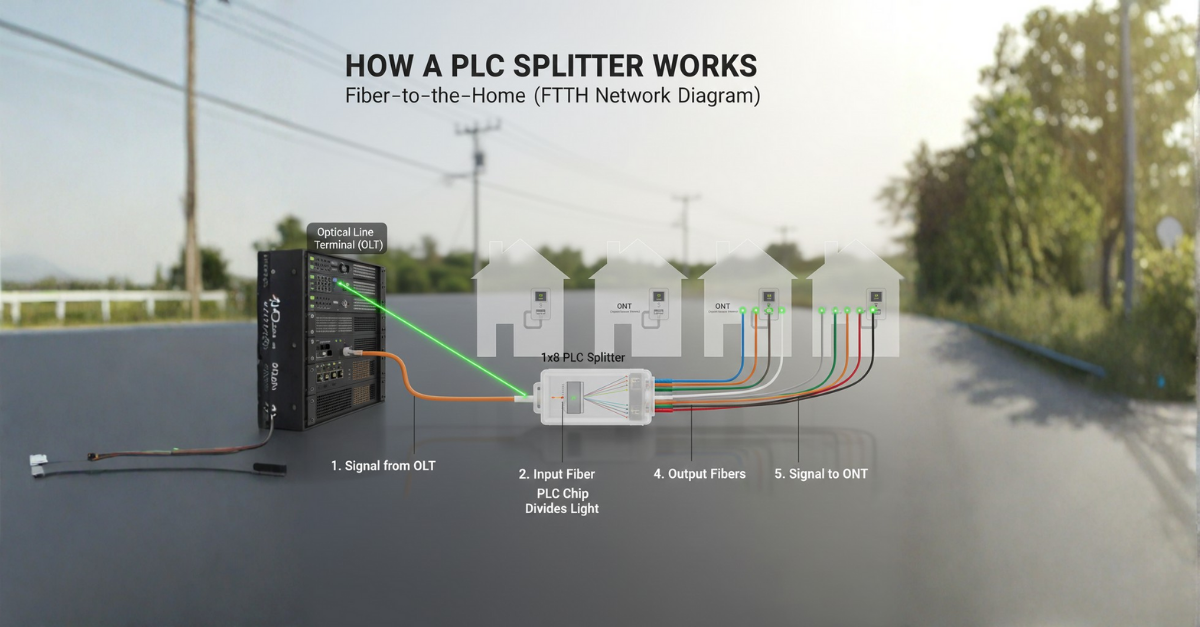
In a Gigabit Passive Optical Network (GPON), the goal is to serve multiple subscribers from a single optical fi ber without using expensive active electronics (like amplifi ers or repeaters) in the fi eld. This passive distribution requires a highly reliable device to divide the light signal uniformly.
The Solution: The PLC Splitter
A PLC splitter is an optical power management device that uses an integrated optical chip to efficiently divide a single incoming optical signal to deliver service to multiple homes.
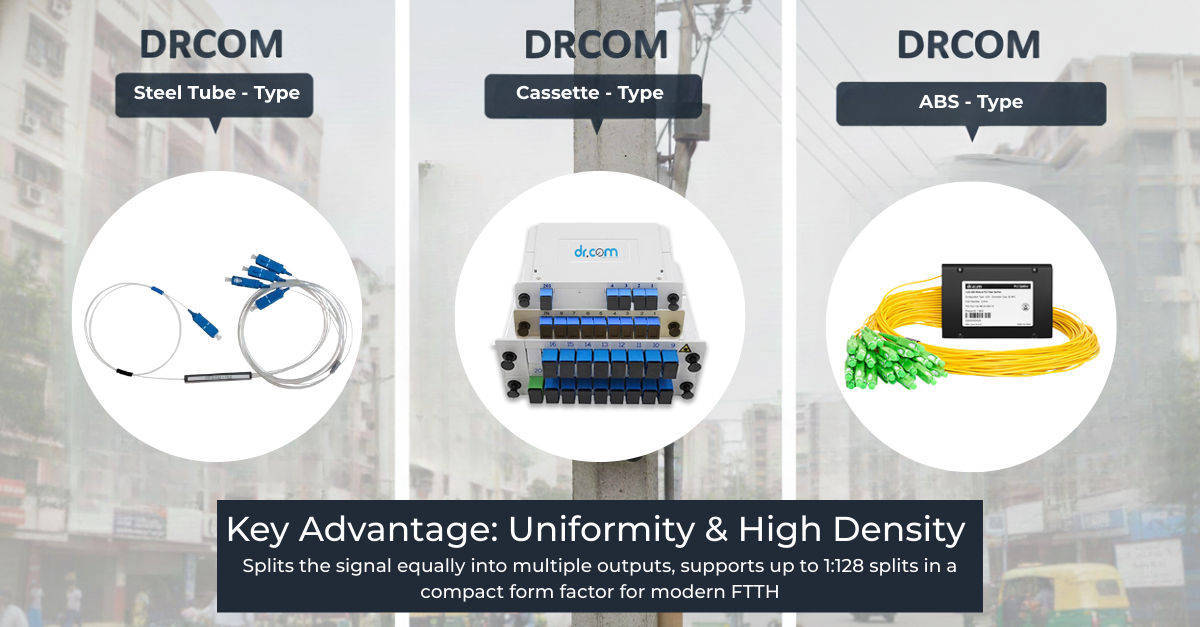
- Key Advantage: Unlike older technologies, PLC splitters are valued for their uniformity across all output ports and their ability to handle large split ratios (up to 1:128) in a compact form factor. This makes them the standard choice for modern high-density FTTH deployments.
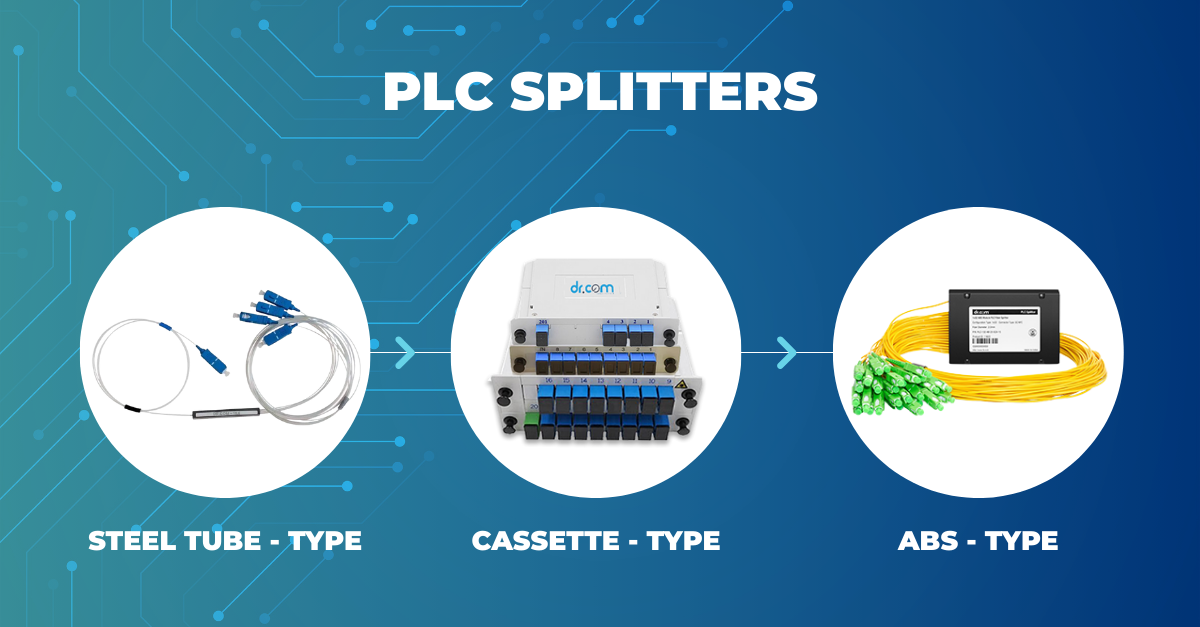
DRCOM offers PLC splitters in various packaging types to suit any deployment scenario:
- Steel Tube - Type: The Steel Tube type is cased in metal for better protection than bare fi ber.
- Cassette - Type: The cassette is indeed the type most commonly used in Fibre Distribution Boxes (FDBs) due to its protective plastic housing.
- ABS - Type:ABS is generally the one for plug-and-play installation in ODFs. This is mostly correct but often refers to a metal box, not just a plastic enclosure.
2. Calculating the Power Budget: The Critical Metric
The most critical factor in choosing a splitter ratio is the optical power budget. This is the total allowable power loss between the Optical Line Terminal (OLT) and the Optical Network Terminal (ONT) at the customer's home.
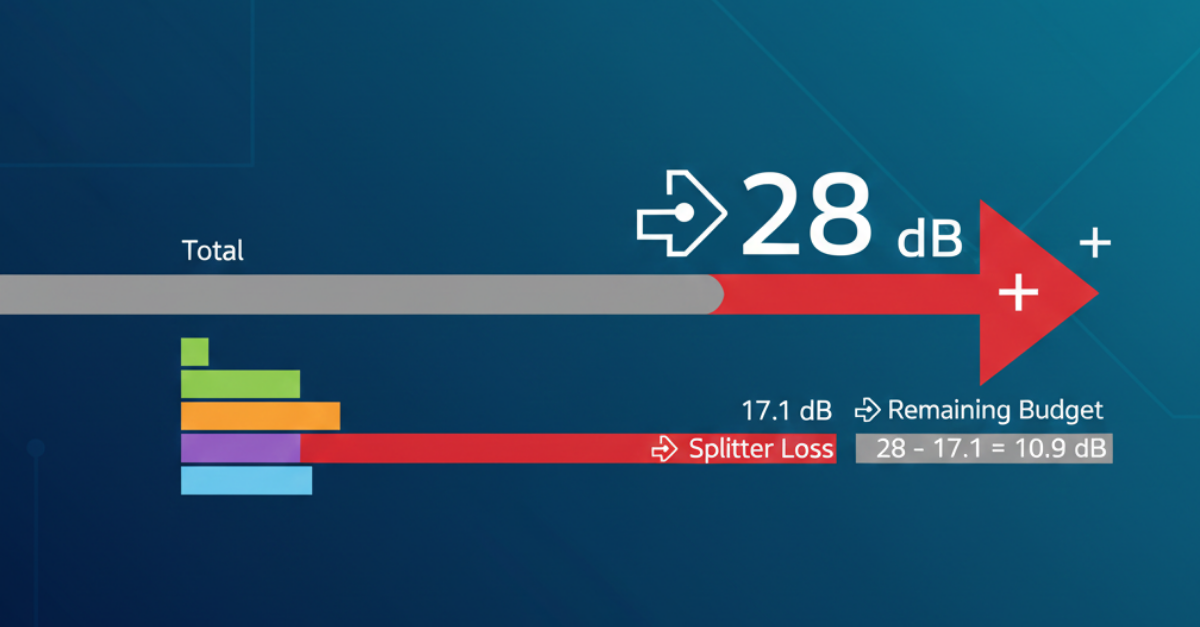
A standard GPON link (Class B+) typically has a maximum budget of 28 dB.
The Loss Formula
You must ensure that the total loss from all network components does not exceed this budget.
Total Loss = Cabling Loss + Splice Loss + Connector Loss + Splitter Loss [cite: 26]
Split Ratios and Typical Loss
The split ratio determines how many customers share a single upstream port on the OLT. Note how quickly the insertion loss consumes the power budget:
Example: If you choose a 1x32 splitter (17.1 dB loss), you only have about 10.9 dB remaining for all other losses (fi ber, splices, connectors) along the entire network path.
3. Maximizing Efficiency: Choosing Your Architecture
The two primary architectures for deploying splitters Centralized and Cascaded offer different trade-offs in terms of fi ber count, cost, and maintenance.
A. Centralized Splitting (Single Stage)
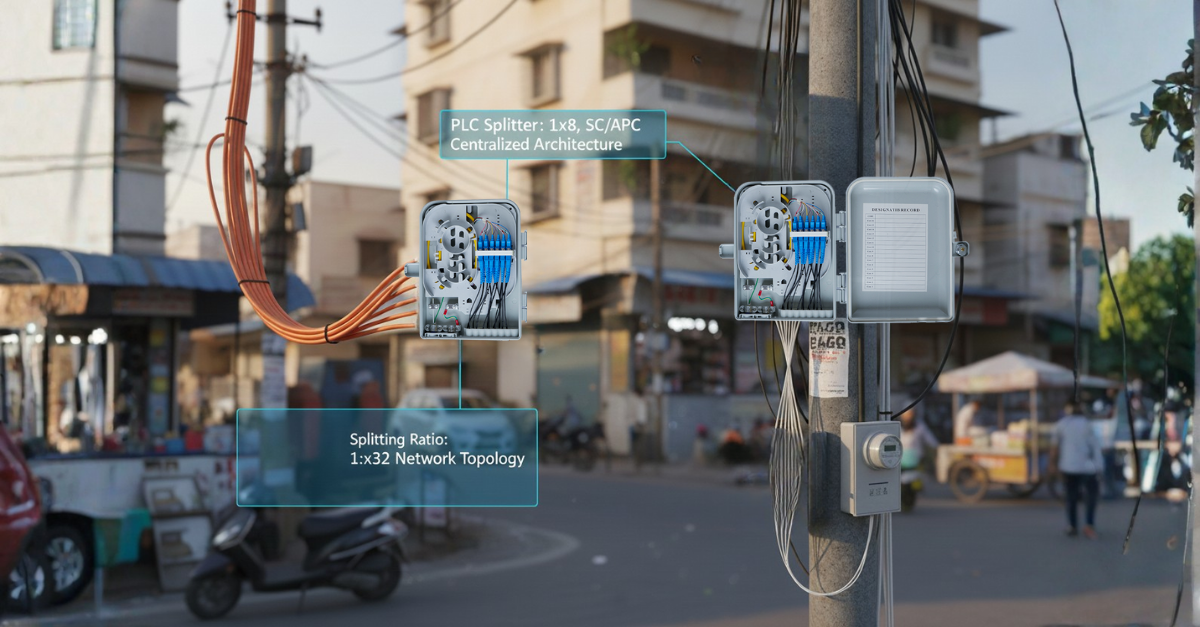
- Architecture: A single large splitter (e.g., 1x32 or 1x64) is placed close to the subscribers in a distribution cabinet.
- Pros: Centralized management, easy testing, and minimal fi ber splicing in the fi eld.
- Cost & Fiber: Requires a dedicated, dense fi ber pair running from the OLT to the distribution point, increasing the initial feeder cable cost.
- Best for: Dense urban areas where subscriber growth is predictable and consistent.
B. Cascaded Splitting (Two Stage)
- Architecture: Uses two or more splitters in series (e.g.,1x4 splitter followed by eight 1x8 splitters to achieve the fi nal 1x32 ratio).
- Pros: Phased deployment, lower initial investment, and better for large geographical areas.
- Cost & Fiber: Allows for a low fi ber count in the initial feeder cable, reducing backbone costs.
- Best for: Suburban or rural areas where deployment is phased or scattered, minimizing feeder fi ber costs.
4. Conclusion: Future-Proofing with Quality Components
The performance of any FTTH network, regardless of the architecture you choose, ultimately depends on the quality of its passive components. Low-grade splitters can introduce unacceptable levels of insertion loss or non-uniformity, quickly draining your power budget. By using TSEC-certifi ed, high-grade PLC splitters and FTTH Accessories from dr-com.com, you ensure minimal loss and maximum signal integrity. This gives you the crucial dB margin needed to confi dently choose higher split ratios and future-proof your network for the next generation of broadband speed.